METI Art ( 2 )

( Edward Tufte's explanation of The Pioneer Plaque,from _Visual Explanations_ [ 01997 ] )

( Edward Tufte's explanation of The Pioneer Plaque,
from _Visual Explanations_ [ 01997 ] )

" We cast this message into the cosmos ... Of the 200 billion stars in the Milky Way galaxy, some -– perhaps many –- may have inhabited planets and space-faring civilizations. If one such civilization intercepts Voyager and can understand these recorded contents, here is our message: We are trying to survive our time so we may live into yours. We hope some day, having solved the problems we face, to join a community of Galactic Civilizations. This record represents our hope and our determination and our goodwill in a vast and awesome universe. "

( 11/31 violates copyright )

( 25/31 also violates copyright )


METI Art

Similar to SETI – the Search for Extraterrestrial Intelligence (Search for ETI), where one listens for messages sent to Earth – METI means "Messaging to ETI": Sending both scientific and artistic messages to the stars. So, METI Art represents not Art about Space, but Art *for* Space. In other words, METI Art is the creative work of Earth destined for inclusion in the Planetary Consciousnesses of supposed extraterrestrial civilizations.

METI is an important quality of a global civilization marked by a mature Planetary Consciousness. The present state of Earth Consciousness is characterized in part by a low level of METI activity. The fact is that our civilization has engaged in about 100 SETI programs, and only one METI Program. Perhaps, at present, the fundamental nature of the Consciousness of Earth is characterized, in part, by a preference to *receive* rather than to *give* ? But however that may be, the scientific and technological aspects of METI are clear: Three terrestrial radar telescopes -– in Arecibo (Puerto Rico), Goldstone (California), and Evpatoria (Crimea) –- can generate signals that are detectable everywhere in the Milky Way Galaxy. In fact, humans have already transmitted four interstellar radio messages toward 16 celestial targets. But, unfortunately, the artistic aspects of METI are in a state of infancy. However, we believe the maturation of METI Art as a widespread art form will evoke an abundance of METI transmissions: With the creation of outstanding works of METI Art, our Planetary Consciousness will greatly shift toward a ‘preference to give’: toward a tendency to share our Planetary Consciousness with the cosmos.

There are at least two peculiar features of METI Art. First, it should be understandable throughout the Universe; or at least we should always strive to achieve this cardinal goal while engaging in the creative process. Second, METI Art should be laconic due to certain technical limitations on the size of interstellar radio messages.

There are at least three sorts of terrestrial Art that are understandable around the world and, presumably, would be understandable by extraterrestrials unfamiliar with Earth: music, dance, and pictures. As an example of pictures we may cite the Arecibo Message, the Cosmic Call 01999 & 02003, the Teen Age Message, and the Bilingual Image Glossary. And as an example of music we may cite the 1st Theremin Concert for Aliens. The language of dance has not yet been used in the creation of METI Art.


Worlds ( 2 )

News that stays News.


worlds-2-kepler-1-casey-cripe.jpg
worlds-kepler-2-casey-cripe.jpg

This animation shows the 2299 high-quality (multiple transits), non-circumbinary transiting planet candidates found by NASA's Kepler mission so far. These candidates were detected around 1770 unique stars, but are animated in orbit around a single star. They are drawn to scale with accurate radii (in r / r* ), orbital periods, and orbital distances (in d / r*). They range in size from 1/3 to 84 times the radius of Earth. Colors represent an estimate of equilibrium temperature, ranging from 4,586 C at the hottest to -110 C at the coldest - red indicates warmest, and blue / indigo indicates coldest candidates. Watching in full screen + HD is recommended, so you can see even the smallest planets! The animation is rendered with a time-step of 30 minutes, equal to the long-cadence time sample of the Kepler observatory. Three white rings illustrate the average orbital distances of Mercury, Venus, and Earth on the same scale. When the system is animated edge-on, it is clear that there is no time during which the sample of stars the Kepler spacecraft is observing does not contain a planet transiting a star. In fact, on average there are dozens of transits occurring amongst the Kepler sample at any given instant. The Kepler observatory has detected a multitude of planet candidates orbiting distant stars. The current list contains 2321 planet candidates, though some of these have already been flagged as likely false-positives or contamination from binary stars. This animation does not contain circumbinary planets or planet candidates where only a single transit has been observed, which is why "only" 2299 are shown. I have illustrated the planet candidates as if they orbit a single star. Using a transit lightcurve, a planet's distance from a star and its radius are both measured in terms of the host stars' radius, and those relationships are preserved here. This means that for two planets of equal size, if one orbits a larger star it will be drawn smaller here. Similarly, because the orbital distances scale with the host stars' sizes, some planets orbit faster than others at a given distance from the star in the animation (when in reality, planets on circular orbits around a given star always orbit at the same speed at a given distance). These faster-moving planets are orbiting denser stars. A fraction of these candidates will likely be ruled out as false positives as time goes on, while the remainder stand to be confirmed as real planets by follow-up analysis. For example, the large orange object in a very close-in orbit was shown to be a background eclipsing binary blend by http://arxiv.org/abs/1207.2481 At the beginning of the animation, the grid of rectangles that briefly appears represents the focal plane array of CCD detectors onboard Kepler. The current list of planet candidates can be found here: http://archive.stsci.edu/kepler/planet_candidates.html More information on the Kepler mission: Mission home: http://kepler.nasa.gov/ Wikipedia: http://en.wikipedia.org/wiki/Kepler_(spacecraft) Follow Kepler on Twitter: http://twitter.com/NASAKepler Follow Alex Parker on Twitter: http://twitter.com/Alex_Parker Music: 2 Ghosts I, Nine Inch Nails. Animation rendered with Python / PyLab. Alex Parker - Postdoctoral researcher in planetary science at the Harvard-Smithsoniain Center for Astrophysics.

Animation showing all the multiple-planet systems discovered by Kepler as of 2/2/2011; orbits go through the entire mission (3.5 years). Hot colors to cool colors (Red to yellow to green to cyan to blue to gray) are Big planets to Smaller planets, relative to the other planets in the system.

Visualization of the planetary systems discovered by Kepler (Batalha et al.), i.e. those targets with more than one transiting object. There are 885 planet candidates in 361 systems, doubling the number of systems in the original Kepler Orrery.

This shows the relative sizes of the orbits and planets in the multi-transiting planetary systems discovered by Kepler up to Nov. 2013. The colors simply go by order from the star (the most colorful is the 7-planet system KOI-351). The terrestrial planets of the Solar System are shown in gray.

All of the Kepler multi-planet systems (1815 planets/planet candidates in 726 systems) from Kepler's original mission as of the announcement of Kepler's end of life: October 30, 2018. The systems are shown together at the same scale as our own Solar System (dashed lines).


Worlds ( 1 )

For more information and stills gallery, please turn to: www.erikwernquist.com/wanderers For youtube version, please turn here: https://www.youtube.com/watch?v=YH3c1QZzRK4 ----- UPDATE: For anyone interested I have made a clip with a few discarded scenes from this film, which can be seen here: https://vimeo.com/132183031 UPDATE: Subtitles added, in English and Spanish, provided by Victor Terrón. Thank you Victor! And in Traditional Chinese by Titus Ou. Thank you Titus! ----- Wanderers is a vision of humanity's expansion into the Solar System, based on scientific ideas and concepts of what our future in space might look like, if it ever happens. The locations depicted in the film are digital recreations of actual places in the Solar System, built from real photos and map data where available. Without any apparent story, other than what you may fill in by yourself, the idea of the film is primarily to show a glimpse of the fantastic and beautiful nature that surrounds us on our neighboring worlds - and above all, how it might appear to us if we were there. As some may notice I have borrowed ideas and concepts from science fiction authors such as Kim Stanley Robinson and Arthur C. Clarke, just to name a few. And visually, I of course owe many tips of my hat to painter Chesley Bonestell - the legendary master of space art. More directly, with kind permission from Ann Druyan I have also borrowed the voice of astronomer and author Carl Sagan to narrate the film. The audio I used are excerpts from his own reading of his book 'Pale Blue Dot: A Vision of the Human Future in Space' (1994, Random House, http://www.penguinrandomhouse.com/books/159735/pale-blue-dot-by-carl-sagan/) - needless to say, a huge inspiration for this film. ----- CREDITS: VISUALS BY - Erik Wernquist - erik@erikwernquist.com MUSIC BY - Cristian Sandquist - cristiansandquist@mac.com WRITTEN AND NARRATED BY - Carl Sagan - from his book 'Pale Blue Dot' http://www.penguinrandomhouse.com/books/159735/pale-blue-dot-by-carl-sagan/, courtesy of Ann Druyan, copyright by Democritus Properties, LLC, with all rights reserved COLOR GRADE BY - Caj Müller/Beckholmen Film - caj@beckholmenfilm.se LIVE ACTION PHOTOGRAPHY BY - Mikael Hall/Vidiotism - mikael@vidiotism.com LIVE ACTION PERFORMANCE BY - Anna Nerman, Camilla Hammarström, Hanna Mellin VOCALIST - Nina Fylkegård - nina@ladystardust.se THANK YOU - Johan Persson, Calle Herdenberg, Micke Lindgren, Satrio J. Studt, Tomas Axelsson, Christian Lundqvist, Micke Lindell, Sigfrid Söderberg, Fredrik Strage, Johan Antoni, Henrik Johansson, Michael Uvnäs, Hanna Mellin THIS FILM WAS MADE WITH USE OF PHOTOS AND TEXTURES FROM: NASA/JPL, NASA/CICLOPS, NASA/Goddard Space Flight Center Scientific Visualization Studio, ESA, John Van Vliet, Björn Jonsson (and many others, of which I unfortunately do not know the names) SUBTITLES PROVIDED BY - Victor Terrón (English, Spanish), Titus Ou (Traditional Chinese)

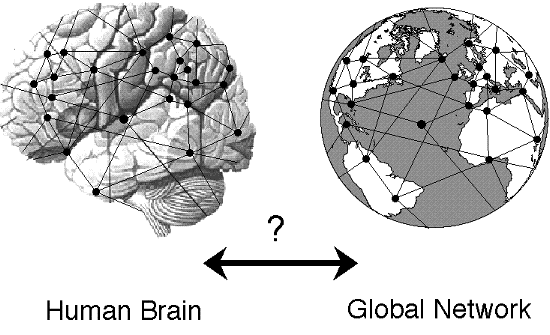
Global Brain ( 1 )

" Is it a fact—or have I dreamt it—that by means of electricity, the world of matter has become a great nerve, vibrating thousands of miles in a breathless point of time? Rather, the round globe is a vast head, a brain, instinct with intelligence: or shall we say it is itself a thought, nothing but thought, and no longer the substance which we dreamed it. "

-- Nathaniel Hawthorne, 
_The House of the Seven Gables_
( 01851 )